Hardware
Nvidia DLSS 5 Brings AI Neural Rendering to Games
April 1, 2026
Read Original: Nvidia NewsroomNvidia unveiled DLSS 5 at GTC 2026 in March, announcing it as the company's biggest graphics breakthrough in nearly a decade. CEO Jensen Huang called it "the GPT moment for graphics," describing it as a shift from performance tools like upscaling and frame generation toward a system that changes how games look at a fundamental level.
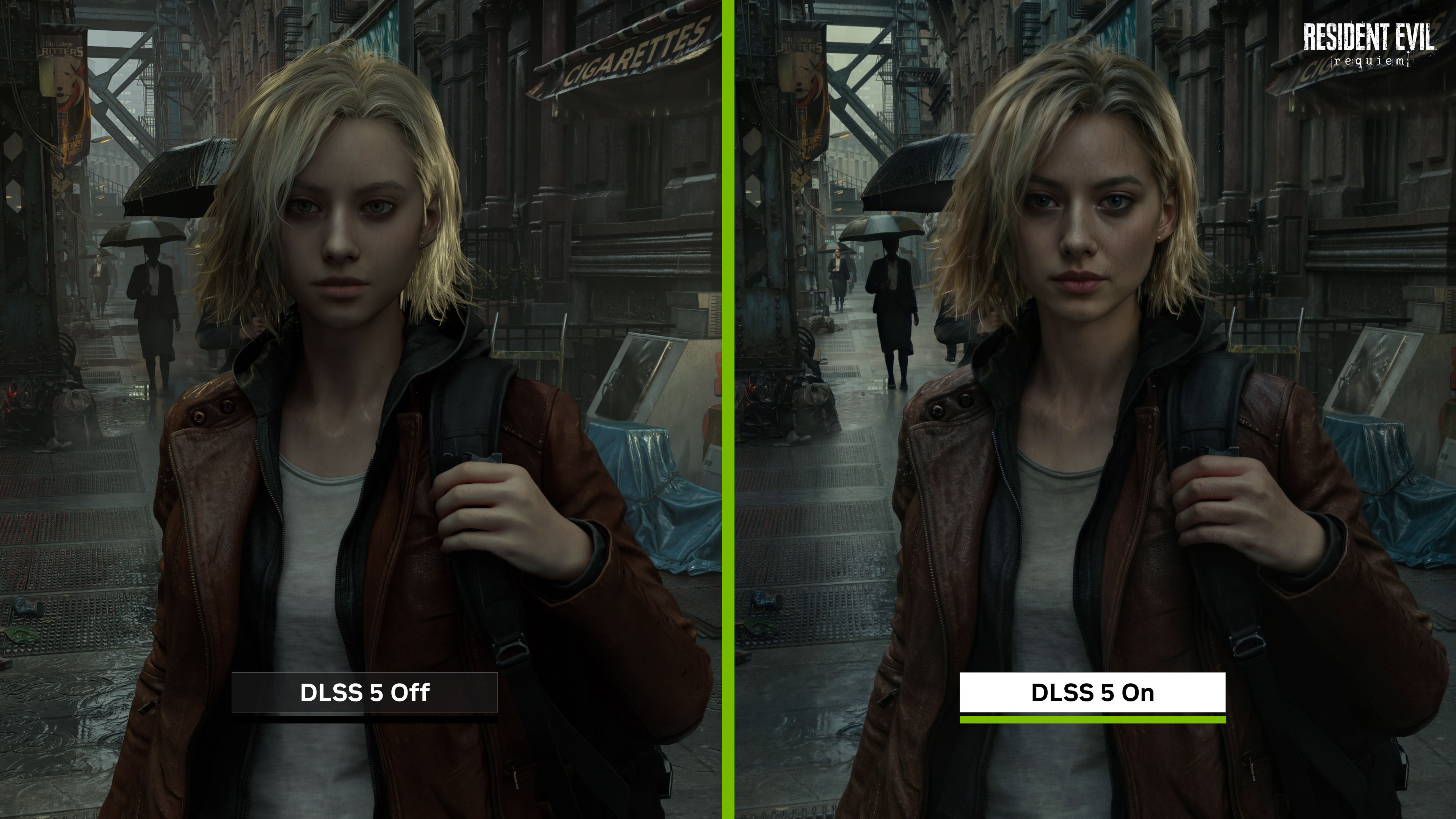
DLSS 5 works by taking each game frame's color data and motion vectors as input, then running an AI model that adds photorealistic lighting and material detail on top of the original 3D scene. The system understands scene elements like skin, hair, fabric, and lighting conditions, and outputs consistent, frame-to-frame results at up to 4K resolution. Developers get controls for intensity, color grading, and masking so they do not lose creative control of the game's visual style. Studios backing the technology at launch include Bethesda, Capcom, Ubisoft, Tencent, NetEase, and Warner Bros. Games.
The reception has not been universally positive. Nvidia ran its GTC demos using two RTX 5090 GPUs, with one dedicated entirely to running the DLSS 5 model. Critics pointed out that the technology is still in early development and that character models in games like Resident Evil Requiem looked noticeably different under the AI-applied filter. Nvidia has pushed back on the criticism, with Huang telling Tom's Hardware that early commenters were "completely wrong" in their assessment.
DLSS 5 is set to ship in fall 2026 on a single GPU. The performance overhead on that single-GPU configuration has not been fully disclosed, and GPU architecture compatibility details are still pending.
For game developers and PC builders, this is the technology to track for the rest of 2026. If Nvidia delivers the single-GPU version at playable overhead, it changes what studios need to invest in to achieve cinematic visuals at runtime.
The line between offline rendering and real-time graphics is narrowing faster than most expected.
Source:Nvidia Newsroom