Software
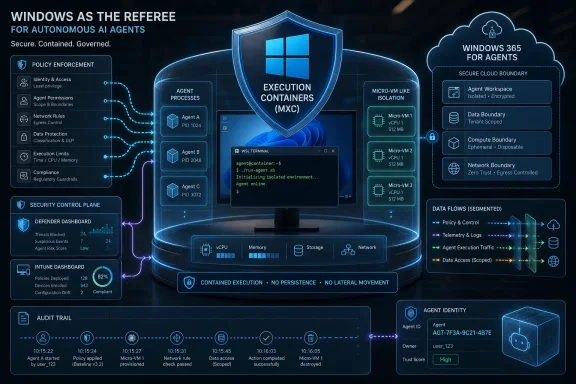
Microsoft Launches Execution Containers for Safer AI Agents
October 10, 2026
Read Original: Microsoft Windows Developer BlogMicrosoft has introduced generally available Microsoft Execution Containers, or MXC, as part of its push to make autonomous AI agents safer to operate. The company detailed the technology in an October 7 Windows Developer Blog post.
AI agents can perform useful tasks across code repositories, files, networks and applications. That flexibility also creates risk: an agent may take an action beyond what its user intended, even when trying to complete a legitimate request. Microsoft's answer is to put independently enforced restrictions around the agent's execution environment.
MXC allows developers and administrators to define which files, directories and network destinations an agent is permitted to use. Those rules are enforced by the container environment rather than by instructions inside the AI model. An agent therefore cannot simply decide to grant itself broader access.
Consider a coding assistant updating a website. It might need permission to edit source files and run development tools, but only read-only access to deployment configuration. A properly configured container could block attempts to modify protected production settings, even if the assistant concluded that changing them would be convenient.
Microsoft describes several isolation options, including process containers across Windows, macOS and Linux; Windows-only session containers; WSL containers; and experimental microVM support on supported systems. Different options offer different trade-offs between performance and separation.
The announcement also outlines future management features. Microsoft plans to distinguish agent identities from human identities through Entra and extend Agent 365 management capabilities to local agents. These features are described as forthcoming rather than universally available today.
For software teams, the larger lesson is that prompt instructions alone are not an adequate security boundary. Agents should receive the minimum permissions necessary, with access controlled by systems outside the model. Activity reporting and policy testing can help organizations refine those restrictions before deploying automated workflows widely.
As AI assistants become more capable, technologies such as MXC could become an important layer of defense between automated work and sensitive systems.